

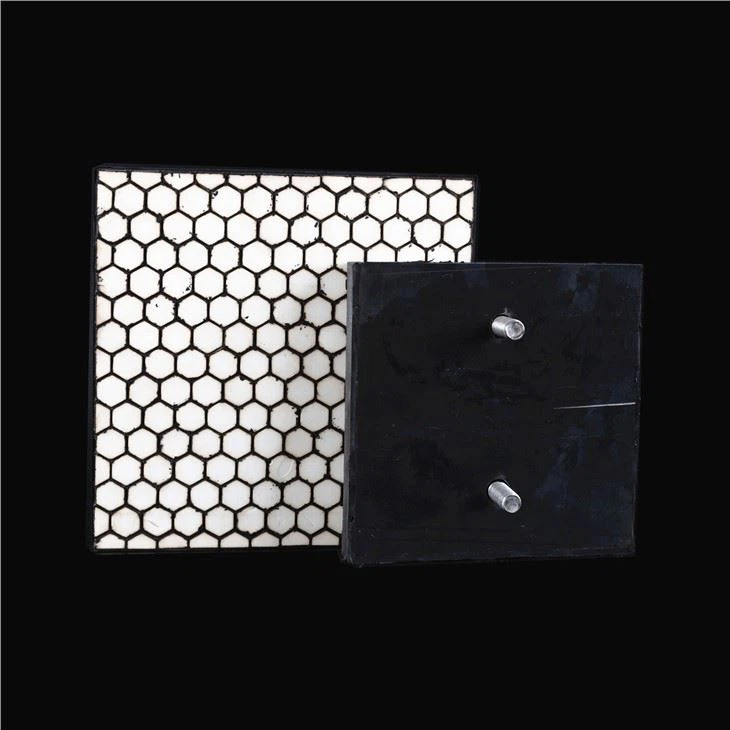


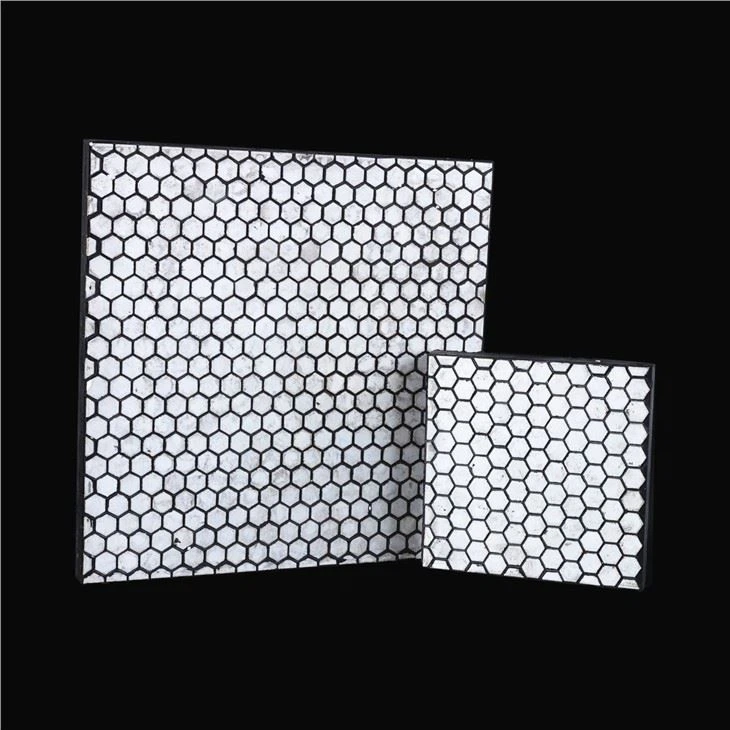


Alumina Rubber Panel
Description
Technical Parameters

Products Description
Alumina rubber panel is specifically designed to extend the service life of equipment exposed to continuous wear and moderate impact. By combining high wear-resistant alumina ceramics with elastic rubber, this panel achieves a balanced combination of hardness, flexibility, and shock absorption that traditional steel lining or independent ceramic lining cannot achieve.
The alumina ceramic layer has excellent resistance to sliding wear, erosion, and particle wear, while the rubber layer effectively buffers the impact force, reduces vibration, and minimizes noise during operation. This double-layer structure helps prevent ceramics from cracking under dynamic loads and improves the overall durability of the lining system. Compared to traditional wear-resistant materials, this composite solution reduces maintenance frequency, minimizes equipment downtime, and lowers replacement costs over long operating cycles. Its lightweight structure also simplifies operation and installation without affecting mechanical strength.
It can also be equipped with embedded steel backplates or installed with studs, allowing for quick installation and reliable connections in chutes, hoppers, transfer points, silos, conveyor loading areas, and other high wear equipment. We also support customized ceramic shapes, panel sizes, and rubber thicknesses to accommodate different particle sizes, impact levels, installation methods, and application requirements, ensuring that each lining solution provides optimal performance for specific industrial processes.
Advantages
1. Wear resistance
High density alumina ceramics have excellent hardness and can significantly reduce wear caused by abrasives such as ore, coal, sand, clinker, cement, and minerals. Compared with traditional steel lining, the service life can be extended several times under the same operating conditions.
2. Excellent impact absorption performance
The elastic rubber layer absorbs the impact energy of falling bulk materials, minimizing the risk of ceramic fracture while protecting the equipment from mechanical impact. This makes alumina rubber panels particularly suitable for handling large particle materials in transfer points, hoppers, and chutes.
3. Reliable adhesive strength
Ceramics and rubber are permanently bonded through high-strength hot vulcanization process to form a durable composite structure. Even under continuous vibration, heavy load, or long-term operation, ceramic tiles can remain firmly attached and will not loosen or fall off.
4. Reduce equipment downtime
Due to its excellent durability, maintenance intervals are greatly extended. Less lining replacement reduces downtime frequency, improves production continuity, and lowers overall maintenance costs in industrial factories.
5. Corrosion resistance and chemical resistance
Alumina ceramics have excellent moisture resistance, acid resistance, alkali resistance, and many industrial chemical properties. This enables the composite lining to maintain stable performance in harsh environments encountered in mining, chemical processing, power generation, and cement production.
6. Flexible installation options
Aluminum oxide rubber sheets can be manufactured using steel backplates, bolts, or CN adhesive layers to accommodate different installation methods, including bolt fixation and adhesive bonding. Customized sizes and ceramic shapes can also be used to match complex equipment.
7. Reduce operating costs
By extending equipment lifespan, reducing wear and tear related failures, and minimizing replacement frequency to the greatest extent possible.
Application
Alumina rubber panels are widely used in industries that experience severe wear and impact simultaneously. The combination of ceramic wear resistance and rubber cushioning helps improve the reliability of equipment while reducing maintenance requirements for various bulk material handling systems.
1. Mining industry
Installed in ore chutes, transfer stations, vibrating feeders, silos, crushers, and conveyor loading points to protect equipment from continuous wear and tear caused by iron ore, copper ore, gold ore, limestone, and other hard minerals.
2. Cement manufacturing
Used for clinker processing systems, raw material hoppers, discharge chutes, bucket elevators, separators, and conveying equipment. Aluminum oxide rubber sheets effectively reduce lining wear caused by highly abrasive cement raw materials and finished products.
3. Coal transportation system
Applied to coal bunkers, conveyor transfer points, crushers, and coal preparation plants, where heavy coal impact and continuous material flow require wear resistance and impact protection.
4. Power plant
Installed in coal-fired power plants to protect coal powder pipelines, coal bunkers, ash removal equipment, and conveying systems, helping to maintain stable factory operation while reducing maintenance downtime.
5. Steel and metallurgical industry
Suitable for sintering plants, blast furnace loading systems, coke processing equipment, and material conveying systems, where abrasive raw materials and high impact loads are common.
6. Port and bulk material loading and unloading
Used for loading hoppers, unloaders, conveyor chutes, and storage facilities, for transporting aggregates, fertilizers, minerals, grains, and other bulk materials, ensuring long-lasting protection of equipment under heavy operating conditions.
7. Chemical and mineral processing plants
Aluminum oxide rubber sheet is an ideal choice for equipment that processes corrosive or abrasive powders and particles, including processing lines for silicon dioxide, phosphate, aluminum oxide, quartz, and various industrial minerals. Its excellent wear resistance and corrosion resistance help extend the service life of equipment while maintaining efficient production.
Technical Data
|
Item/Product |
HA 92 |
HA95 |
ZTA |
|
Al2O3(%) |
92±0.5 |
95±0.5 |
76±0.5 |
|
ZrO2(%) |
|||
|
Bending Strendth(Mpa) |
>220 |
>280 |
>400 |
|
(Mpam1/2)Fracture Toughness |
>3.60 |
>3.90 |
>4.50 |
|
Rockwell Hardness (HPV) |
>82 |
>88 |
>90 |
|
Wear Volume(cm³) |
<0.50 |
<0.30 |
<0.15 |
Production process
To guarantee consistent stable performance of every batch of alumina rubber panel, our factory implements closed-loop quality supervision covering raw material incoming inspection to finished shipment, with dedicated full-time quality inspectors stationed at each production node:
1. Raw Material Strict Screening & Preprocessing
95% alumina ceramic blanks are purchased from self-owned high-purity sintering production lines; each batch undergoes Al₂O₃ content, hardness and wear loss testing before warehousing. Rubber raw materials adopt customized anti-aging flame-retardant formula with automatic precision weighing to eliminate manual proportion deviation. Bottom steel plates receive Sa2.5 sandblasting oxide scale removal to upgrade vulcanization bonding strength.
2. Precision Ceramic Mosaic & Constant-Temperature Vulcanization
Automatic positioning equipment arranges semi-spherical ceramic particles evenly on rubber substrates for uniform gap distribution. Three-layer composite blanks enter flat vulcanizers under 12MPa constant pressure and 145℃ fixed temperature for 25-minute curing, forming integrated chemical bonding without post-assembly glue weak points.
3. Finished Defect Screening & Multi-Item Lab Testing
Workers manually pick out defective liners with ceramic falling, rubber bubbling or steel plate deformation after vulcanization. Qualified products enter independent labs for seven full-item tests including alumina composition, bending strength, wear volume and vulcanization peel force; factory-sealed inspection reports attach to every shipment, supporting third-party designated testing fully.
4. Moisture-Proof Anti-Collision Packaging
Before Delivery Finished liners are separated by shockproof foam sheets, fixed on fumigation-free wooden pallets and wrapped with waterproof plastic film to avoid collision damage during long-distance sea container loading and transportation.
Why choose our huao's alumina rubber panel?
1. Strict quality inspection
Each production batch undergoes a comprehensive inspection, including dimensional accuracy, ceramic density, hardness, adhesive strength, and visual inspection. This quality control process ensures consistency in product performance before shipment.
2. Professional manufacturing experience
With years of experience in industrial wear-resistant ceramics, our engineering team understands various material transportation challenges. We assist customers in selecting suitable lining solutions based on application environment, material characteristics, impact level, and operating temperature.
3. Stable supply and global export services
We maintain efficient production capacity and flexible manufacturing schedules to meet standard and customized orders. Professional export packaging, complete testing reports, and timely delivery help customers reduce procurement risks and project delays.
4. Customized manufacturing solutions
Different conveying systems require different wear protection solutions. We offer customized aluminum oxide rubber sheet sizes, ceramic shapes, thicknesses, rubber hardness, and steel backing options to match specific operating conditions and installation requirements.
FAQ
Q1: Can the panel withstand wear and impact?
A1: Yes. The ceramic layer has excellent resistance to sliding wear, while the rubber layer buffers the impact force. Compared to traditional lining, this dual functional structure helps to extend the lifespan of equipment.
Q2: Are there customized specifications?
A2: Yes. We can produce customized alumina rubber sheet products according to customer requirements, including ceramic size, alumina content, rubber thickness, steel plate backing, embedded bolts, bolt holes, and external dimensions.
Q3: How is the panel installed?
A3: The installation method depends on the application. Common options include bolt fixation, welded steel backplate, adhesive bonding, or mechanical fastening. Our engineers can recommend the most suitable installation method based on your equipment.
Q4: What factors should be considered when making a choice?
A4: Important factors include material type, particle size, impact force, operating temperature, equipment structure, installation space, and expected service life. These conditions help determine the appropriate ceramic thickness and rubber configuration.
Q5: How long can alumina rubber sheets usually be used?
A5: The service life varies depending on operating conditions, material wear and tear, impact level, and maintenance practices. Under appropriate application conditions, the service life of this panel is much longer than traditional steel lining, thereby reducing replacement frequency and maintenance costs.
Immediately request a quote for your alumina rubber sheet and get competitive prices and fast global delivery!
Hot Tags: Alumina Rubber Panel, China, manufacturers, suppliers, factory, customized, buy, Alumina Ceramic Packing Ball, Mosaic Tiles, Alumina Lining Tile, White Tabular Corundum, irconia Ceramic Beads, Alumina Ceramic Grinding Balls
Previous
Alumina Ceramic Grinding BallSend Inquiry


