



92% 95% Alumina Ceramic Grinding Balls / Wet Grinding Balls / Dry Grinding Balls

92% 95% Alumina Ceramic Grinding Balls / Wet Grinding Balls / Dry Grinding Balls
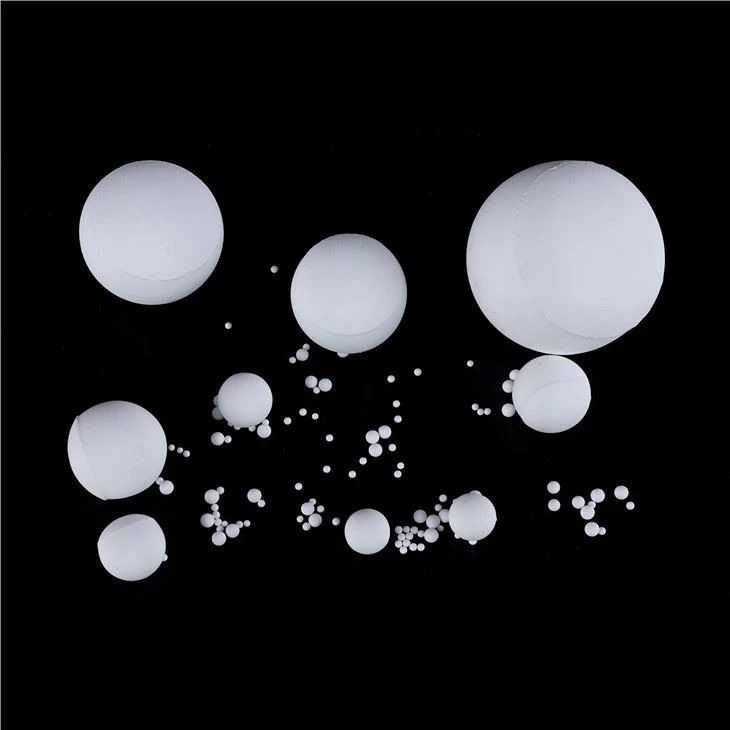
92% 95% Alumina Ceramic Grinding Balls / Wet Grinding Balls / Dry Grinding Balls

92% 95% Alumina Ceramic Grinding Balls / Wet Grinding Balls / Dry Grinding Balls

92% 95% Alumina Ceramic Grinding Balls / Wet Grinding Balls / Dry Grinding Balls

92% 95% Alumina Ceramic Grinding Balls / Wet Grinding Balls / Dry Grinding Balls
92% Dry Grinding Balls
Description
Technical Parameters

Products Description
Compared with wet systems, dry grinding processes have different requirements for grinding media: higher impact loads on freely falling materials, increased internal temperatures caused by continuous friction, and stricter requirements for anti fragmentation in dusty environments. To address these issues, the product adopts an optimized alumina ceramic formula and specially adjusts the grain boundary composition, effectively improving crack propagation resistance and reducing fragmentation and fracture rates during long-term drying operations.
Production follows strict isostatic pressing and high-temperature sintering workflows. High purity alpha alumina powder is formed under isostatic pressing to achieve uniform green density without internal defects. Then the formed object is sintered in a tunnel kiln above 1650 ℃, and the temperature curve is precisely controlled to allow the crystal to grow completely and form a dense corundum structure. After sintering, the balls undergo multi-level screening, size classification, and appearance inspection to ensure size consistency and surface integrity.
Unlike wet alumina balls that prioritize ultra-low wear loss in liquid environments, 92% dry grinding balls focus more on impact resistance and thermal stability, making them more adaptable to the harsh working conditions of dry ball mills. They are compatible with various dry grinding equipment, including tube ball mills, vibration mills, and gas sweep mills, which can directly replace steel balls and natural pebbles without the need for equipment modification, helping enterprises achieve clean production and higher grinding efficiency.
Advantage
1. Strong impact resistance
In a dry ball mill, compared to a wet grinding environment, the grinding medium falls freely from a higher height and bears greater impact force. Ordinary ceramic balls designed for humid conditions are prone to breakage under sustained impact. This product has optimized the grain boundary bonding strength through formula adjustment, effectively absorbing impact energy and suppressing crack propagation. Under normal dry grinding conditions, the crushing rate is controlled at an extremely low level, avoiding production interruptions caused by a large number of crushed balls.
2. Ultra low wear loss ensures powder purity
For dry processed powders such as white cement, high-grade calcium carbonate, and ceramic raw materials, the impurity content directly affects the product grade and appearance. Traditional steel balls introduce iron ions during the grinding process, resulting in yellowing of the powder and a decrease in quality. 92% dry grinding balls are made of high-purity alumina, which has stable chemical properties and extremely low self wear. They do not introduce metal impurities or colored pollutants into the material, effectively improving the whiteness and purity of the finished powder, and reducing the subsequent purification process.
3. High packing density increases grinding yield
The bulk density of this product is 3.60 g/cm ³, and its specific gravity is significantly higher than that of natural pebbles and ordinary medium alumina balls. At the same filling amount and mill speed, each grinding ball carries greater impact energy, which can more effectively crush material particles, shorten the grinding cycle, and increase the hourly output of the mill. For large-scale dry production lines, even a 10% increase in efficiency can bring significant output growth and energy savings.
4. Stable performance at high temperatures
Long term continuous operation of dry grinding equipment can lead to a continuous increase in internal temperature, and the temperature of some high-intensity grinding sections may exceed 100 ℃. Unlike polymer grinding media that easily soften at high temperatures, alumina ceramics maintain stable mechanical properties at temperatures up to 1000 ℃, and their hardness and wear resistance do not decrease with increasing temperature. It can adapt to various high-temperature dry grinding conditions and maintain stable performance during long-term continuous operation.
Applications
1. Processing of ceramic raw materials
The ceramic industry requires precise control of powder fineness and material purity. Alumina ceramic grinding balls are widely used for grinding ceramic raw materials such as clay, feldspar, quartz, etc. Its stable wear characteristics help manufacturers achieve a more uniform particle distribution and improve the consistency between the ceramic body and the final product.
2. Mineral powder production
The mining and mineral processing industry often deals with hard materials that experience severe wear and tear in grinding equipment. Ceramic grinding media can be used to process non-metallic minerals and industrial powders, effectively reducing particle size while minimizing contamination of grinding components.
3. Chemical and specialty material preparation
Many chemical products require fine powder preparation before further processing. Due to its chemical stability, ceramic balls are suitable for grinding materials that may react with metal media. They help maintain material purity while supporting stable production conditions.
4. Pigments and Coatings Industry
Color consistency is an important quality factor for pigments and coatings. During the grinding process, unwanted impurities can affect the appearance and performance of the product. Ceramic grinding media provide a cleaner processing environment, helping manufacturers achieve finer particles and better dispersion.
5. Electronics and advanced ceramic materials
Modern electronic components and advanced ceramics typically require high-quality powders with controllable particle size. Alumina ceramic balls are used in precision grinding processes because they provide reliable performance and reduce the possibility of introducing metal contaminants into sensitive materials.
Size Specifications
Wet Grinding
|
Brand |
HA-92 |
HA-92S |
HA-95 |
|
AL2O3(%) |
≥92 |
≥92 |
≥95 |
|
Bulk density(g/cm³) |
≥3.65 |
≥3.68 |
≥3.68 |
|
Hardness(Mohs) |
9 |
9 |
9 |
|
Wear Loss(%) |
≤0.01 |
≤0.008 |
≤0.01 |
|
Water Absorption(%) |
≤0.01 |
≤0.01 |
≤0.01 |
|
Color |
White |
White |
White |
Dry Grinding
|
Brand |
HA-92 |
HA-95 |
|
AL2O3(%) |
≥92 |
≥95 |
|
Bulk density(g/cm³) |
≥3.60 |
≥3.65 |
|
Hardness(Mohs) |
9 |
9 |
|
Wear Loss(%) |
≤0.015 |
≤0.012 |
|
Water Absorption(%) |
≤0.01 |
≤0.01 |
|
Color |
White |
White |
|
Size |
13-90mm |
|
|
Size can be customized according to customer's requirement |
||
Parameter Explanation
The packing density directly determines the impact kinetic energy of the grinding medium. The higher the density, the stronger the crushing force per unit volume, which directly improves the dry grinding efficiency.
The wear amount reflects the self consumption rate during operation. Lower wear loss means longer service life and less impurities entering the processed powder.
A water absorption rate below 0.01% indicates that the internal structure is completely dense without any openings, which is the basis for maintaining stable performance in dry and humid environments.
Customized sizes can be provided upon request to match specific rolling mill models and process requirements.
Why choose our HUAO's 92% dry grinding ball?
As a professional manufacturer specializing in wear-resistant alumina ceramic products, we have long been committed to the research and production of industrial grinding media, providing stable and reliable products and full process technical support to global customers.
1. Whole process quality control system
We implement strict quality control from raw material inspection to finished product delivery. Each batch of products undergoes ingredient testing, density testing, wear testing, and drop impact testing to ensure that all indicators meet the standards. A complete batch traceability record can provide customers with stable and consistent product quality.
2. Customized solution support
We offer a full size range from 13mm to 90mm and support customized production for special sizes and performance levels. Our technical team can provide targeted grinding medium selection, grading design, and loading solutions based on customers' mill parameters, material characteristics, and production requirements, helping customers maximize grinding efficiency and reduce costs.
3. Adequate production capacity and reliable delivery
We have multiple automated isostatic pressing production lines and large tunnel kilns, with a monthly production capacity sufficient to meet the needs of large industrial customers. Maintaining long-term safety stock for regular specifications can ensure fast delivery of small and medium-sized orders, and production can also be arranged for large orders according to the agreed delivery time.
4. Full cycle technical services
We not only provide products, but also offer full cycle technical support, including pre-sales solution design, in sales loading guidance, and after-sales operation optimization. If customers encounter any problems during use, they can contact us at any time, and our technical team will respond and provide solutions within 24 hours.
FAQ
A1: What is the main use of 92% alumina ceramic grinding balls?
A1: 92% alumina ceramic grinding balls are commonly used in grinding processes that require good wear resistance, chemical stability, and cost-effectiveness. They are widely used in powder processing industries such as ceramic materials, minerals, coatings, and chemicals.
Q2: What is the difference between dry grinding and wet grinding?
A2: Dry grinding does not add liquid during the grinding process, while wet grinding uses water or other liquid media to improve dispersion and reduce dust. The choice depends on the material properties, production requirements, and final product specifications.
Q3: How should customers choose the appropriate grinding ball size?
A3: The correct particle size depends on several factors, including raw material hardness, initial particle size, target fineness, mill type, and production capacity. Appropriate combinations of different sizes can improve grinding efficiency and reduce energy consumption.
Q4: Will alumina grinding balls affect product purity?
A4: Alumina ceramic grinding balls have low wear loss and good chemical stability. Compared with some traditional grinding media, they can effectively reduce unnecessary pollution during material processing, making them suitable for industries with purity requirements.
Do you need reliable ceramic grinding media? Contact us immediately for your grinding solution.
Hot Tags: 92% Dry Grinding Balls, China, manufacturers, suppliers, factory, customized, buy, Alumina Ceramic Grinding Media For Cement Mill, Alumina Grinding Ball, High Alumina Ceramic Grinding Cylinder, Alumina Wet Grinding Ball, Alumina Ceramic Inert Packing Ball, Ceramic Ball
Previous
92% Alumina Ceramic Grinding BallSend Inquiry


