

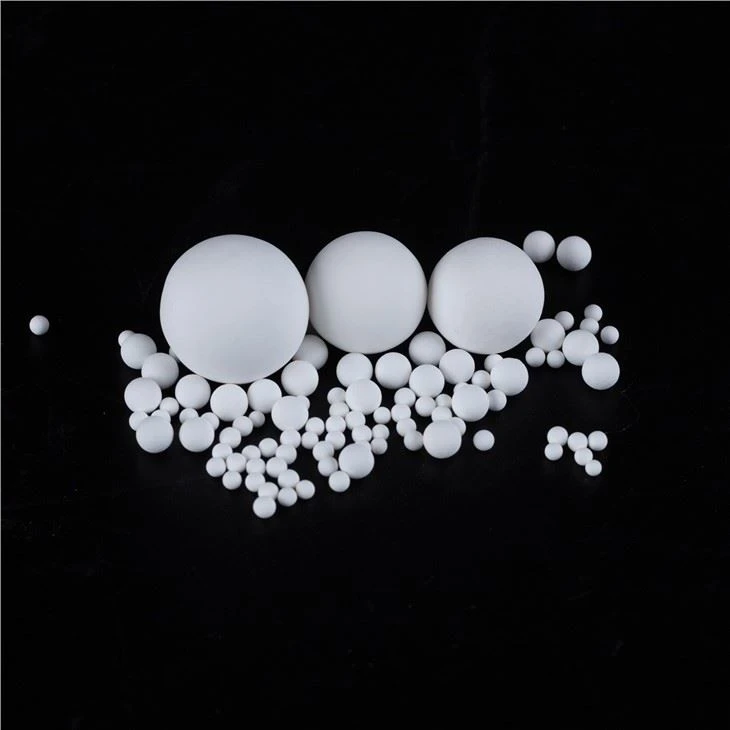


Inert Alumina Ceramic Ball
Description
Technical Parameters

Products Description
In a fixed bed reactor, catalyst particles only occupy the middle part. Above and below are inert sphere layers that perform critical structural and hydraulic functions. Without them, the high-speed feed gas will fluidized and carry the catalyst downstream, causing uneven settling of the bed, resulting in cross flow and hotspots, and the catalyst weight will crush the particles at the bottom grid. Inert alumina ceramic balls solve these problems by providing a rigid, porous, and chemically stable packing layer that maintains its geometric shape under high temperature, high pressure, thermal cycling, and corrosive fluids.
This product has a grade of 92% to 99.5% alumina and a diameter of 3mm to 100mm, specified by the reactor designer, requiring predictable compressive strength, thermal stability, and chemical resistance.
Advantages
1. Support and protection of catalyst bed
The main function of inert alumina ceramic balls is to support the weight of the catalyst bed above the support grid and cover the catalyst below to prevent fluidization, entrainment, and carrying into downstream equipment. A moderately sized inert sphere layer, typically 100-300mm thick at both the top and bottom of the catalyst bed, forms a physical barrier that holds the catalyst particles in place while allowing the process fluid to freely pass through the gaps.
2. Uniform fluid distribution to reduce cross flow
When the process gas or liquid enters the reactor, it must be evenly distributed across the entire cross-section of the catalyst bed to ensure that each catalyst particle is utilized and prevent cross flow - the preferred flow path that leads to uneven reaction rates, hotspots, and premature catalyst deactivation. The inert sphere layer acts as a flow distributor: the random accumulation of spheres forms a tortuous, interconnected network of voids, breaking the inlet jet and evenly redistributing the fluid. The specific surface area and porosity of the ball layer are carefully designed to provide optimal distribution without generating excessive pressure drop.
3. Pressure drop optimization
The pressure drop in the reactor bed directly affects the energy consumption and operating costs of the compressor. Inert alumina balls provide a controlled porosity of 38-42%, significantly higher than the porosity of typical catalyst particles (25-35%). This means that the inert ball layers at the top and bottom of the implant provide support and distribution while minimizing pressure drop. The reactor designer carefully selects the ball diameter related to the catalyst particle size - typically 2-3 times the diameter of the inert ball - to ensure that the ball does not interlock or crush the catalyst particles at the interface.
Application
Petroleum refining
In refineries, inert alumina ceramic balls are used in hydroprocessing units, hydrocracking units, reforming units, isomerization units, and Claus sulfur recovery reactors.
Petrochemical and chemical processing
Inert balls are used in steam cracking furnaces, ethylene oxide reactors, methanol synthesis circuits, ammonia converters, and styrene units in petrochemical plants.
Natural gas processing
The natural gas plant uses inert balls (CO ₂/H ₂ desulfurization), molecular sieve dehydration unit, mercury removal bed, and NGL fractionation tower in the amine scrubbing tower. In the amine processor, the ball supports and distributes the amine solution in reverse flow with the gas. In the molecular sieve dryer, balls support and cover the zeolite bed (250-300 ° C) that undergoes thermal cycling during the regeneration process. HA-92 and HA-92 levels are the standards.
Product parameter
| Brand | HA-92 | HA-95 | HA-99 | HA-99.5 |
| AL2O3(%) | ≥92 | ≥95 | ≥99 | ≥99.5 |
|
Fe2O3(%) |
≤0.2 | ≤0.15 | ≤0.1 | ≤0.05 |
| Bulk Density (g/cm3) | ≥3.20 | ≥3.40 | ≥3.50 | ≥3.60 |
| Packing Density (g/cm3) | 1.80 | 1.85 | 2.00 | 2.10 |
| Unit Compressive Strength (13mm/N) | ≥5000 | ≥5500 | ≥6000 |
How to choose the ball diameter?
The selection of ball diameter follows two principles:
1. Support layer (bottom): The ball diameter should be 2-3 times the catalyst particle size to prevent the catalyst from falling out of the gap. For 1.6mm catalyst extruded material, use 6-8mm support balls; For a 3mm catalyst plate, use a ball of 10-13 mm.
2. Cover layer (top): The ball diameter should be 3-5 times the catalyst particle size to prevent fluidization and entrainment at high gas velocities. For a 1.6mm catalyst, use a 13-20mm cap ball.
3. Hierarchical layers: In large reactors, multiple hierarchical layers are composed of ordinary large spheres at the support grid, medium spheres in the middle, and smaller spheres at the catalyst interface to optimize support strength and distribution.
Why choose us?
When you specify inert alumina ceramic balls for the Zibo factory in Shandong, you will collaborate with a manufacturer to control the entire production chain from raw material selection to molding, sintering, screening, and inspection. This vertical integration ensures consistency in quality between batches - our compressive strength standard deviation for each batch is less than 8%, one of the strictest in the industry - and competitive factory direct pricing without any middleman markup.
We offer a full range of alumina grades from 92% economical to 99.5% ultra pure, with diameters ranging from 2mm to 150mm, including custom sizes and graded layer packaging. Our technical team collaborates with reactor designers, catalyst licensees, and end-users to recommend the optimal grade, size, and loading configuration based on operating conditions such as temperature, pressure, fluid composition, catalyst type, and size. We can provide reactor loading drawings, pressure drop calculations, and compatibility assessments for specific process chemistry.
FAQ
Q1: What is the difference between inert alumina balls and alumina grinding balls?
A1: Although both are spherical alumina ceramics, their design functions are completely different. Grinding balls are consumable media used in ball mills to grind and crush materials through impact and wear - they wear out over time and need to be replaced regularly. Inert balls are structural packing elements used in reactors and towers to support catalyst beds, distribute fluid flow, and reduce pressure drop - their design aims to maintain chemical and physical stability for many years without wear or participation in reactions. The manufacturing specifications, quality standards, and failure modes are completely different.
Q2: How to determine the correct ball size for the reactor?
A2: The size of the ball depends on two factors: catalyst particle size and reactor function. For the bottom support layer, the ball diameter should be 2-3 times the catalyst particle size to prevent the catalyst from falling off. For the top cover layer, the ball diameter should be 3-5 times the catalyst diameter to prevent fluidization at the design gas velocity. Many reactors use graded layers - larger balls at the grid, medium in the middle, and smaller at the catalyst interface. The catalyst licensor or reactor designer should specify the exact size and layer depth.
Q3: Which grade of alumina should I use?
A3: The level selection depends on the operating temperature, corrosiveness of the process fluid, and sensitivity to contamination. General guidance: 17-23% suitable for low temperature, non corrosive, and cost sensitive applications; For medium conditions and general refinery services, 65-75%; 92% used in high temperature and acidic/corrosive environments (most common grade); 95% under severe conditions; For ultra-high purity, pollution sensitive processes (polymers, electronic products, food grade) and temperatures above 1400 ° C, over 99%. Our engineers can provide suggestions based on your specific process conditions.
Company Information
Zibo Huao New Materials Co.,Ltd is located in Shandong Zibo, it is a professional company for R&D Design, manufacture and sale Alumina Particular kind of Ceramic Products.
Huao always adhere to the principle of quility first, customers first and reputation first, their products are widely used in ceramic, mining,petroleum, chemical industry, electric power, papermaking, cement,aerospace, military industry and other fields. The markets covered Europe and the United states, the Middle East, Sountheast Aisa,Japan, South Korea and other regions and countries. Warmly welcome friends from all over the world to join hands with Huao and thank you for your support!
Hot Tags: Inert Alumina Ceramic Ball, China, manufacturers, suppliers, factory, customized, buy, Alumina Lining Tile, Alumina Ceramic Packing Ball, White Tabular Corundum, Alumina Ceramic Grinding Balls, Ceramic Mocaic Tiles, Zirconia Alumina Balls
Previous
alumina ceramic grinding ballSend Inquiry