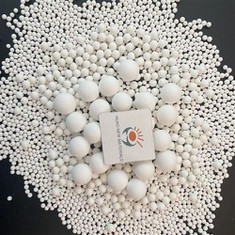


Alumina Inert Packing Balls
Description
Technical Parameters

Products Description
Alumina inert packing balls, also known as inert ceramic balls or alumina balls, are high-purity spherical tower fillers designed specifically for catalyst bed support and flow regulation in industrial reaction vessels. This series has a minimum alumina content of 92% and a completely dense crystal structure, providing absolute chemical inertness as well as excellent compression and heat resistance. It serves as a stable bottom backing and top cover layer to protect expensive catalysts while ensuring uniform fluid distribution in all types of chemical towers.
core function
For most chemical plant procurement teams, tower packing is often considered a low priority auxiliary component, but its performance has a cascading impact on catalyst efficiency, energy consumption, and overall operating costs. Low quality ordinary ceramic fillers have three common hazards that can disrupt continuous production cycles.
Once fillers containing high-speed rail and silica impurities are exposed to high-temperature reaction media, irreversible catalyst poisoning will occur, forcing complete replacement of the catalyst, which will result in hundreds of thousands of raw material and shutdown losses.
2. Insufficient compressive strength of a single sphere can lead to the catalyst bed being too heavy and broken, producing fine powder, blocking fluid channels, and increasing tower pressure drop.
3. Uneven spherical roundness can cause chaotic fluid flow inside the tower, leading to local overreaction and inconsistent product quality.
Unlike typical low aluminum ceramic balls, our Huao's alumina inert packing balls simultaneously addresses these three pain points. It has three irreplaceable core functions in the reactor layout: bottom load-bearing support, upper bed cushion coverage, and interlayer flow homogenization. Each application design we provide is matched with tower diameter, working pressure, and medium corrosiveness to eliminate flow dead zones inside the equipment.
Advantages
1. Absolute chemical inertness
The dense crystal matrix of alumina inert packing balls limits impurity leaching to ultra-low limits. When in contact with petroleum fractions, ammonia, desulfurization flue gas, and weak organic solvents, the spheres do not participate in oxidation, reduction, or acid-base neutralization reactions. No foreign matter dissolves in the process flow, fully protecting the catalyst activity and ensuring the purity of the finished product.
2. High compression structural integrity
The standard 13mm specification achieves a minimum single ball compressive strength of 5500N. Even in tall fractionation towers with catalyst beds several meters thick, the packing maintains its complete spherical geometry over years of static stacking, avoiding powder generation and pipeline blockage.
3. High temperature resistance
The stable continuous working temperature can reach 850 ° C and can withstand transient peak heat waves up to 900 ° C. Hydrocracking and reforming reactors will not undergo softening, deformation, or thermal cracking under long-term high-temperature cycling.
4. Controlled low water absorption rate
The internal non connected micropores limit the water absorption rate to below 5%, eliminating the medium retention that causes local temperature fluctuations and uneven reaction rates inside the tower equipment.
5. Spherical uniformity
Strict size screening can maintain consistent roundness for each batch of products. The stacking of rules forms a uniform porosity to balance the gas-liquid contact area and tower pressure loss, optimize reaction conversion efficiency without causing excessive energy waste.
Application
1. Refining and Petrochemicals
Application of alumina inert packing balls in hydrocracking reactors, catalytic reformers, and fractionation towers; They bear the weight of the catalyst bed, prevent fine catalyst leakage, buffer high-speed feed impact, and optimize gas-liquid contact efficiency.
2. Fertilizers and synthetic ammonia
Used for ammonia synthesis towers, urea reactors, and desulfurization systems; The high purity grade avoids catalyst poisoning caused by heavy metals and significantly extends the service life of the catalyst.
3. Natural gas and coal chemical industry
Deploy in desulfurization/decarbonization towers and coal gasification shift reactors; They filter dust and tar from the raw gas and resist long-term corrosion from acidic gas media.
4. Metallurgy and Coking
Used for coke oven gas scrubbers and metallurgical flue gas scrubbers; They intercept tar and solid particles and maintain stable performance in highly corrosive flue gas environments.
Technical Data
|
Brand |
HA-92 |
HA-95 |
HA-99 |
HA-99.5 |
|
AL2O3(%) |
≥92 |
≥95 |
≥99 |
≥99.5 |
|
Fe2O3(%) |
≤0.2 |
≤0.15 |
≤0.1 |
≤0.05 |
|
Bulk density(g/cm³) |
≥3.20 |
≥3.40 |
≥3.50 |
≥3.60 |
|
Packing density(g/cm³) |
1.80 |
1.85 |
2.00 |
2.10 |
|
Unit compressive Strength(13mm/N) |
≥5000 |
≥5500 |
≥6000 |
≥7000 |
|
Water Absorption(%) |
≤5 |
≤5 |
≤5 |
≤5 |
|
Color |
White |
White |
White |
White |
|
Noted: Water absorption can be customized according to customer's requirement |
||||
Noted
When using alumina inert packing balls, attention should be paid to cleaning and drying the storage area to avoid dust pollution and prevent dust from falling on the ceramic balls and causing pollution. Ceramic balls are a type of ceramic product with a certain degree of brittleness. Compared with metals, they have weaker resistance to rapid cooling and heating, so their market price is lower. During the freeze-thaw process, it is necessary to avoid sudden heating and rapid cooling, which can cause the ceramic ball to rupture. Long term use of the ceramic ball will adsorb impurities in the process gas, and regular inspections should be conducted every year. If impurities are blocked, they should be cleaned or replaced in a timely manner according to the situation of impurities.
FAQ
Q1: What is the fundamental difference between alumina inert packing balls and alumina grinding balls?
A1: These two products are designed for completely different working environments and performance goals. Priority should be given to chemical inertness, low heavy metal impurities, and high static compressive strength of the tower catalyst support for packing balls. Grinding balls focus on the wear resistance of material grinding and contain high levels of trace impurities. If used in reaction towers, it can cause catalyst poisoning. Mixing these two products will result in permanent deactivation of the catalyst and increase the operating costs of the factory.
Q2: Can the layered tower packing be mixed with multiple particle sizes?
A2: Yes. Our technical team calculates the optimal size ratio based on your tower height, catalyst particle size, and flow rate. We offer pre mixed mixed size packaging to save on-site sorting labor and reduce filling errors during maintenance downtime.
Q3: What is the maximum continuous temperature that A-95 grade packing can withstand?
A3: The long-term stable working temperature can reach 850 ° C, and the instantaneous thermal shock can reach 90 ° C. It is suitable for the working conditions of most medium and high temperature petrochemical and fertilizer reaction towers.

Hot Tags: Alumina Inert Packing Balls, China, manufacturers, suppliers, factory, customized, buy, White Tabular Corundum, Zirconia Alumina Balls, irconia Ceramic Beads, Ceramic Mocaic Tiles, Alumina Ceramic Grinding Balls, Alumina Ceramic Packing Ball
Send Inquiry