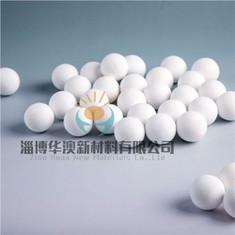


95% Al2O3 Balls
Description
Technical Parameters

Products Description
Cement production is one of the most energy intensive manufacturing processes, with grinding - raw material preparation, clinker grinding, and coal powder preparation - accounting for 60-70% of the total electricity consumption in cement plants. The grinding medium inside the ball mill is not just a consumable; It is the active ingredient that transfers kinetic energy from the rotating mill housing to the ground material, and its physical properties - density, hardness, toughness, wear resistance, and surface smoothness - directly determine the grinding efficiency, energy consumption, medium replacement frequency, and even the chemical composition of the finished cement. 95% Al2O3 balls represent a carefully optimized balance point in the alumina grinding media product line: compared to 92% balls, higher purity and density can significantly reduce wear and extend service life, while 95% grade avoids the significant cost premium of 99% ultra-high purity balls, making it the most cost-effective choice in most cement grinding applications.
Compared to the two alternative solutions they typically replace, the performance advantage becomes evident. High chromium steel balls have a higher density (7.6-7.8 g/cm ³), but their Mohs hardness is only 6.8 (compared to 9 for alumina), resulting in higher wear losses (0.18 vs. 0.09 g/kg · h). Cement is severely contaminated with iron (white cement and special cement are unacceptable), and the load on the mill motor is higher. 92% of alumina balls solve pollution and weight issues, but their lower density (3.60 vs. 3.70 g/cm ³) and higher glass phase content (5-8% vs. 3-5%) result in higher wear losses (0.10-0.15 ‰ vs. 0.05-0.10 ‰) and shorter service life. 95% of the grade is located at the intersection, and the increase in purity from 92% to 95% results in a disproportionate reduction in wear (30-50%), while the cost increase is typically only 15-25%, with the lowest total cost per ton of cement throughout the entire service life of the medium.
Advantages
1. 30–50% Lower Wear Loss Than 92% Balls
The 95% Al2O3 Balls deliver wear loss of 0.05–0.10‰ per 24 hours, compared with 0.10–0.15‰ for 92% alumina balls-a 30–50% reduction. This difference comes from two microstructural factors: first, the higher alumina content means less SiO₂-CaO-Na₂O glassy phase at grain boundaries (3–5% vs. 5–8%), and the glassy phase is the weakest link in the wear mechanism-it is preferentially plucked out during ball-ball and ball-material collisions, exposing the underlying α-Al₂O₃ grains to further attrition. Second, the higher sintering density (3.70 vs. 3.60 g/cm³) means fewer internal pores that act as crack initiation sites during impact. In a cement finish mill grinding 1 million tons of clinker per year, this wear reduction translates to approximately 50–100 fewer tons of media consumed annually and 2–4 fewer media top-up operations per year.
2. 20–30% Energy Savings vs. Steel Balls
When a cement plant converts from high-chromium steel balls to alumina ceramic balls, the most immediately measurable benefit is a reduction in specific grinding energy consumption. This energy saving comes from three mechanisms: (1) Lower mill charge weight-alumina balls have a bulk density of approximately 2.2–2.3 t/m³ (randomly packed), compared with 4.5 t/m³ for steel balls, meaning the same mill volume charge weighs roughly half as much, reducing the motor torque required to lift and cascade the charge. (2) Higher grinding efficiency per unit mass-the higher hardness (Mohs 9 vs. 6.8) and smoother surface of alumina balls mean more kinetic energy is transferred to material fracture and less is lost to media deformation, friction, and wear. (3) Reduced overgrinding-the more uniform size distribution and consistent sphericity produce a narrower cement particle size distribution, reducing the fraction of overground fines that waste energy. Field data from cement plant conversions typically show 20–30% reduction in finish mill specific energy, with some plants reporting up to 35% in optimized circuits.
3. Zero Iron Contamination for White and Specialty Cement
High-chromium steel balls wear during grinding, and the iron and chromium particles shed from the ball surface become incorporated into the cement. For ordinary Portland cement, this iron pickup is generally negligible (50–200 ppm). However, for white cement, the iron content directly determines whiteness-white cement requires Fe₂O₃ below 0.5%, and even 100 ppm of additional iron from grinding media can measurably reduce whiteness and require additional bleaching operations. For sulfate-resistant cement, oil-well cement, and low-alkali cement, strict limits on Fe₂O₃, Cr₂O₃, and alkali content make steel media contamination unacceptable. These balls eliminate this contamination source entirely: the only wear particles are alumina, chemically identical to the Al₂O₃ component already present in cement raw materials.
quality assurance
Each batch of 95% Al2O3 balls undergoes comprehensive quality control:
1. Raw material inspection: Each batch of calcined alumina powder is tested for chemical composition using XRF (Al2O3, SiO ₂, Na ₂ O, Fe ₂ O3), CaO), Particle size distribution (D50, D90) was measured by laser diffraction, and volatile content was measured by LOI. Only powders with aluminum content ≥ 95% and sodium content ≤ 0.2% are released into production according to the specifications.
2. Process monitoring: Check the weight and diameter of the raw balls in each molding batch. The kiln temperature is continuously recorded by multiple thermocouples along the tunnel kiln, with peak temperatures controlled between 1550-1650 ° C ± 15 ° C. The combustion curves (heating rate, peak dwell time, cooling rate) for each batch have been archived.
3. Finished product testing:
Bulk density: Geometry/Archimedes method, 20 balls per batch and size; Acceptance ≥ 3.70 g/cm ³.
Water absorption rate: Boiling method according to GB/T 2997; Acceptance rate ≤ 0.01%.
Apparent porosity: boiling/mercury method; Acceptance rate ≤ 0.05%.
Al2O3 content: XRF analysis of crushed samples; Acceptance rate ≥ 95%.
Mohs hardness: scratch test; Accept 9.
Compressive strength: universal testing machine, 10 balls per batch and size; Acceptance pressure ≥ 2250MPa.
Wear amount: Conduct a 24-hour ball mill wear test according to enterprise standards; The acceptance rate is ≤ 0.10 ‰.
Dimensional inspection: Measure the diameter and sphericity of 100% of the balls through automatic optical sorting; Acceptance within the specified tolerance range.
Visual inspection: 100% inspection of the ball for cracks, debris, pits, and discoloration through automatic optical sorting and manual spot checks.
4. Pre shipment documents: Each shipment includes a batch test report (covering all the parameters mentioned above), certificate of origin, Material Safety Data Sheet (MSDS), and packaging photos. Third party inspections (SGS, BV, Intertek) can be provided upon request.
Technical Specifications
| Property | 92% Al₂O₃ | 95% Al₂O₃ | 99% Al₂O₃ |
| Al₂O₃ Content (%) | ≥92 | ≥95 | ≥99 |
| SiO₂ Content (%) | ≤5.0 | ≤3.0 | ≤0.5 |
| Fe₂O₃ Content (%) | ≤0.2 | ≤0.15 | ≤0.05 |
| Na₂O Content (%) | ≤0.3 | ≤0.2 | ≤0.1 |
| Bulk Density (g/cm³) | ≥3.60 | ≥3.70 | ≥3.90 |
| True Density (g/cm³) | ≥3.65 | ≥3.75 | ≥3.95 |
| Apparent Porosity (%) | ≤0.1 | ≤0.05 | ≤0.02 |
| Water Absorption (%) | ≤0.01 | ≤0.01 | ≤0.005 |
| Mohs Hardness | 9 | 9 | 9 |
Why choose us?
When you purchase 95% Al2O3 balls from our HUAO, you will collaborate with a manufacturer to control the entire production chain from calcined alumina powder selection to roll forming or isostatic pressing, high-temperature tunnel kiln sintering, automatic optical sorting, and packaging. This vertical integration ensures the strictest inter batch consistency in the industry - our standard deviation for bulk density is less than 0.02 g/cm ³, and the standard deviation for wear loss is less than 0.01 ‰ - which means we can trace each ball back to its raw material batch, molding batch, and kiln firing record.
Our technical team provides support for optimizing the grinding circuit of cement mills: we analyze your mill specifications (diameter, length, chamber configuration, lining type, separator type), operating conditions (feed, feed particle size, target fineness, productivity, current specific energy consumption), and current medium performance (wear rate, feeding frequency, feeding grading), and then recommend the best 95% alumina particle size grading, feeding filling percentage, and medium conversion plan. For factories that convert steel balls to alumina balls, we provide a step-by-step conversion guide that includes expected energy savings, reduced medium consumption, calculation of investment payback period, and operational adjustment recommendations (mill speed, separator settings, loading).
FAQ
Q1: Can 95% alumina balls directly replace steel balls in my existing cement mill?
A1: Yes, but the conversion requires careful planning as the bulk density of alumina balls is approximately half that of steel balls (2.2-2.3 t/m ³ vs. 4.5 t/m ³). Direct 1:1 volume replacement will result in a significant reduction in loading, decreased motor load, and possibly insufficient grinding energy - you may need to increase the loading percentage (typically from 28-32% for steel to 32-38% for alumina) to maintain grinding capability. The applicability of the grinder motor should be checked (most modern VFD drive motors can handle reduced loads, but older constant speed motors may need to be adjusted). The separator (if it is a closed-circuit mill) may need to be readjusted as the alumina balls will produce a narrower particle size distribution. We provide a detailed conversion plan, including recommended material grading, filling percentage, expected energy-saving effects, and operational adjustments based on your specific mill specifications.
Q2: What is the expected service life of 95% alumina balls in a cement finishing mill?
A2: The service life depends on the wear resistance of the clinker, mill diameter, mill speed, loading amount, target fineness, and ball diameter. Typical range: The clinker finishing mill grinds OPC to 3500 Blaine - full load for 18-30 months (regularly topped up to maintain grading); High wear clinker or finely ground to 5000+Bryan -12-18 months; Raw material factory -24-36 months; Coal mill -30-48 months. These are estimated total charging life values; In practice, the factory fills up the material once a month or quarter to replace the balls with minimal wear and maintain the target gradation. When the average ball size drops below the minimum effective size or the breakage rate increases, the entire material will be replaced. The wear loss of 95% steel balls (0.05-0.10 ‰ every 24 hours) is a key parameter for calculating the expected life and filling frequency.
Q3: Will alumina balls cause pollution or quality issues to cement?
A3:No-95% alumina balls are actually beneficial for cement quality compared with steel balls. The only wear particles from alumina balls are Al₂O₃, which is already a normal component of cement raw materials and clinker (typically 4–6% Al₂O₃ in OPC clinker). The small amount of additional alumina from media wear (typically 50–150 g/ton cement, or 0.005–0.015% by weight) is negligible and does not affect cement chemistry. In contrast, steel balls shed iron and chromium particles (typically 200–500 g/ton cement) that increase the Fe₂O₃ and Cr₂O₃ content of the cement, which is unacceptable for white cement, sulfate-resistant cement, oil-well cement, and low-alkali cement. Alumina balls also produce a narrower cement particle size distribution, which improves strength development consistency and reduces water demand.
Q4: What particle size grading should my cement mill use?
A4: The optimal grading depends on the type of mill, chamber configuration, feed size, target fineness, and mill diameter. General start-up suggestion: Large clinker precision rolling mill (Φ 3.5-4.5 meters, two chambers) - first chamber: 40% 50mm+35% 40mm+25% 30mm; Second chamber: 30% 30 mm+40% 25 mm+30% 20 mm. Medium sized clinker mill (Φ 2.5-3.5 m) -25% 50 mm+30% 40 mm+25% 30 mm+15% 25 mm+5% 20 mm. Raw material grinder -15% 60mm+25% 50mm+30% 40mm+20% 30mm+10% 25mm. Coal mill -20% 40 mm+35% 30 mm+30% 25 mm+15% 20 mm. These are the starting points; The optimal grading should be verified by measuring the performance of the mill (productivity, specific energy, Brian fineness, residue) and adjusting the grading based on the results. We provide customized grading recommendations based on your specific mill and operating conditions.
Hot Tags: 95% Al2O3 Balls, China, manufacturers, suppliers, factory, customized, buy, 95 Alumian Ceramic Ball, ZTA Ball, Alumina Wet Grinding Ball, Alumina Grinding Ball, Alumina Ceramic Inert Packing Ball, Alumina Ceramic Grinding Ball
Previous
92% Dry Grinding BallsSend Inquiry