

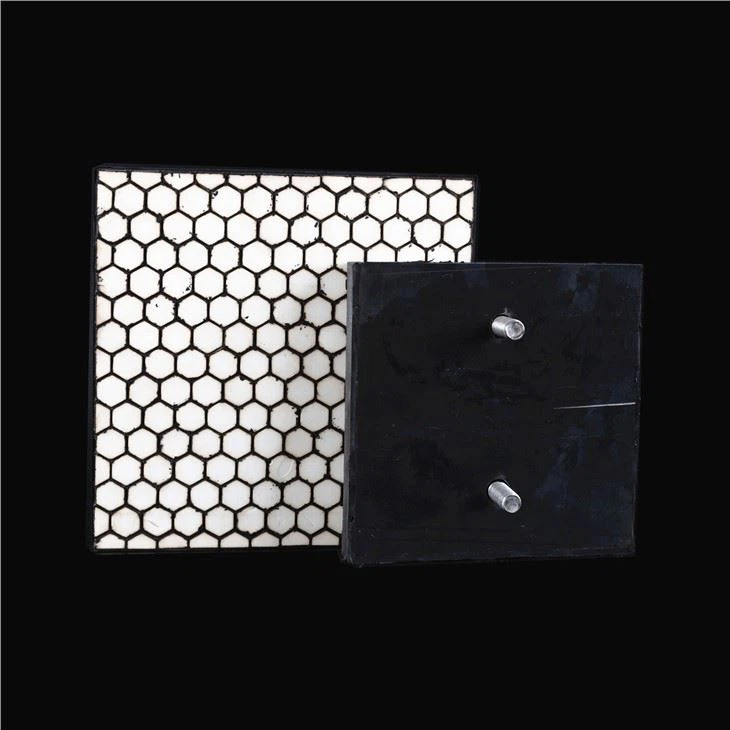


Ceramic Rubber Panel With Steel
Description
Technical Parameters

Products Description
The difference between a wear-resistant lining that lasts for three years and a wear-resistant lining that fails within three months in bulk material handling often lies in how the lining is connected to the equipment casing, rather than what material it is made of. The double-layer ceramic rubber sheet bonded by adhesive has reliable performance in low vibration and low impact areas (such as flat silo walls and gentle slope chutes), but in high impact transmission points, ball mill inlet pipes, and vibrating feeders, cyclic impact loads and structural bending will gradually fatigue the adhesive, leading to panel detachment. Once the panel falls off, the exposed steel shell will wear out within days or even hours, leading to unplanned shutdowns and expensive emergency repairs. The three-layer panel of ceramic rubber panel with steel integrates the structural steel backplate with pre welded threaded bolts, creating a mechanical bolt connection that will not detach regardless of impact energy, vibration, or temperature cycling, solving this basic connection problem.
The panel configuration can be adjusted to fit the actual installation area. Huao's current standard panel sizes range from 200 × 200 mm and 300 × 300 mm to larger sizes such as 500 × 500 mm and 600 × 600 mm. Customized panel configurations can also be provided based on equipment drawings, dimensions, and required lining structures.
Advantages
1. Mechanical bolt connections cannot be detached
The ceramic rubber panel with steel eliminates the most common failure mode of double-layer ceramic rubber lining: adhesive bonding fatigue. In high impact and high vibration environments, adhesive is loaded in a shear and peel manner with each impact. After thousands of cycles, even the highest quality industrial epoxy resin will gradually develop microcracks at the interface, ultimately allowing the panel to lift and separate. The steel backplate with pre welded threaded bolts forms a pure mechanical connection: the bolts pass through the equipment casing and are fixed externally with nuts, which means the panel is fixed by steel to steel friction and mechanical interlocking, rather than through any chemical bonds. This connection is not affected by impact energy, vibration frequency, temperature cycling, or humidity, and provides a predictable and verifiable accessory that maintenance teams can verify by checking nut torque during routine inspections.
2. Three layer impact energy dissipation system
Each layer helps to form a continuous chain of impact energy dissipation, which can reduce the peak force reaching the equipment casing by 80-90% compared to bare steel or hard surface lining. When ore or clinker impacts the panel: (1) The hard alumina ceramic layer can resist immediate cutting and chiseling, preventing abrasive wear; (2) The elastic rubber layer compresses under impact, converts kinetic energy into elastic strain, and slowly releases it during rebound - this is the main energy absorption mechanism, reducing peak force by 60-80%; (3) The rigid steel backing distributes the remaining load over a larger area of the shell, preventing local deformation and fatigue cracking. A 50kg ore block falling 3 meters (with an impact energy of approximately 1500J) will generate a peak shell force equivalent to only 150-300J, while the impact force of bare steel lining is 1200-1500J.
3. Maintenance downtime reduced by 70%
In a continuous processing plant, unplanned downtime for lining replacement can cost tens of thousands of dollars per hour. The modular design of bolted connections transforms lining replacement from a major event to a daily task. When the panel is damaged (usually due to a single extreme impact causing several tiles to break, or local wear after years of use), the maintenance team only needs to remove the nut from the outside, slide the damaged panel out from the inside, place a new panel, and tighten the nut. The total time for each panel is 5-10 minutes, without the need for special tools, adhesives, or waiting for curing, and there is no risk to adjacent panels. In contrast, replacing the adhesive panel requires chiseling out the cured adhesive (which usually damages the shell), polishing the shell smooth, mixing and applying new adhesive, positioning the panel, and waiting for 12-24 hours for complete curing. For typical chute lining involving 20-30 panels, the bolt system reduces the total maintenance time from 2-3 days to 4-6 hours.
Applications
1. Coal conveying chute
When bulk materials are moved from one conveyor or processing stage to another conveyor, the coal conveying equipment will be repeatedly impacted. Points where coal changes direction or falls on lower surfaces may experience concentrated wear. Composite ceramic rubber lining can be installed in these areas to protect the steel shell, while the rubber layer helps absorb some of the impact generated by falling materials.
2. Coal hoppers and bunkers
The hopper receives materials before they are discharged to another device. The lower section and impact zone usually bear more severe loads than the upper wall. Therefore, the lining thickness and ceramic arrangement can be selected based on the material's falling distance and flow pattern, rather than applying the same specifications throughout the entire hopper.
3. Ash removal system
In thermal power generation facilities, ash conveying equipment may come into continuous contact with abrasive particles. Transfer points, chutes, and discharge sections are typical locations where lining protection may be required. The composite structure provides a hard ceramic working surface while retaining an elastic layer between the ceramic and the device casing.
4. Steel and sintering plants
Steel plants handle some of the most abrasive and high-temperature materials in bulk processing: iron ore (sinter and pellet), coke, limestone, and slag. The requirements for sintering plants are particularly high: sintered ore (a porous, glassy, highly abrasive aggregate of iron ore, flux, and coke powder) is discharged from the sintering cooler at 150-300 ° C and transported to the blast furnace feed system through chutes and transfer points. The combination of high temperature, high wear, and continuous impact makes sintering plant chutes one of the most challenging wear-resistant lining applications. The panel with nitrile rubber (NBR, rated temperature of 120 ° C continuous, 150 ° C intermittent) is designated for use in sintering plant feed tanks, discharge hoppers, and vibration feed tanks. Bolt connection is crucial in the application of vibrating feeders, as continuous high-frequency vibration (15-30Hz) can quickly peel off the adhesive liner. In the blast furnace casting workshop, these panels are used for slag granulation chutes and iron ore/flux batching hoppers, where strong mechanical connection linings are required for impact, wear, and occasional high-temperature splashes.
Parameter list
| Panel Size | 300x300, 200x200, 225x225, 250x250, 400x400, 425x425, 500x500, 600x600 |
| Ceramic Size | Ceramic tiles are available from 10x10mm to 100x150mm; thickness of ceramic tile can be from 1.5mm to 50mm |
| Backing Plate | Steel plate with thickness ranging from 3mm to 10mm(optional) |
| Rubber Thickness | Depends upon the impact stress expected or customer requirement. |
| Remarks |
Metal+Rubber+Ceramic/Rubber+Ceramic Plain surface or Spherical. Studs also availiable upon request Custom shapes can be made. |
quality assurance
Each batch of steel backed composite panels undergoes a comprehensive quality control protocol, covering all three layers:
1. Ceramic tile inspection
Perform bulk density, apparent porosity (≤ 0.1%/≤ 0.05%), AL2O3 content (XRF, acceptance ≥ 92%/≥ 95%), and dimensional tolerance (tile thickness ± 0.3mm, length/width ± 0.5mm) on each batch of tiles. Ceramic tiles with gaps, cracks, or dimensional defects before vulcanization will be rejected.
2. Rubber compound testing
Perform Shore A hardness (± 5 of the target value), tensile strength (NR ≥ 18 MPa/NBR ≥ 15 MPa), elongation at break (NR ≥ 350%/NBR ≤ 300%), and tear strength (≥ 35 kN/m) tests on each batch of rubber. The bonding strength between rubber and ceramics, as well as rubber and steel, shall undergo a 90 ° peel test in accordance with GB/T 7760, and the acceptance shall be ≥ 6kN/m.
3. Inspection of steel backing and stud welding
Verify the material grade (factory certificate review), flatness (≤ 2 mm/m), and plate thickness (± 0.3 mm) of the steel plate. The stud welds are inspected by visual inspection (100%) and torque testing (10% sample, tightened to 1.5 times the rated torque, without fracture or looseness).
4. Finished panel inspection
Check the tile coverage of each finished panel (no missing tiles, gap width between tiles ≤ 1.5mm), rubber surface (no gaps, bubbles or delamination), screw position (deviation from the drawing ± 2mm), panel flatness (≤ 3mm/m) and external dimensions (± 2mm). Panels that do not meet any inspection standards will be reworked or rejected.
5. Pre shipment documents
Each shipment includes a batch test report (covering all the above parameters), steel backing material certificate, rubber compound data sheet, installation and maintenance manual, and packaging photos. Third party inspections (SGS, BV, Intertek) can be provided upon request.
Company Information
Zibo Huao New Materials Ltd. Is located in Zibo City, Shandong Province -- the Ceramic Capital of China, it is a modern high-tech company for design, providing and sales. We are specially engaged in providing, process and sales of high-alumina wear-resistant products, good heat resistant products, abrasive resistant equipment and machines. Products are high temperature resistance, high hardness, corrosion resistance, low wear loss, low expansion coefficient and light weight. And they are widely used in ceramic, mining, cement, iron, chemical industry, paint, paper-making, medicine, military industryand other fields. The markets covered Europe and the US, the Middle East, Southeast Asia, Australia, Russia, Japan and other regions and countries. We are also provide tabular alumina, the production capacity is 15000 tons now, will increase to 30, 000 tons in the future, and all of alumina are imported(Australia) alumina, quality more stable and reliable. The bulk density of tabular alumina more than 3.5g/cm3, test result always over 3.53G/cm3. Through the unremitting efforts of all staffs, the company′s products have been sold around the world, nearly 30 countries of resistant material and refractory enterprises use our products. We make that dare to be first and create unlimited as own responsibility, make high quality products, quality service and competitive prices to meet customers needs as tenet. Keeping innovating and forging ahead. We are looking to provide the philosophy of sincerity and the principle of customers first to warmly welcome friends from all over the world to join hands with us.
FAQ
Q1: What is ceramic rubber panel with steel?
A1: It is a composite wear-resistant plate that combines alumina ceramic, elastic rubber layer, and steel backing plate. These three materials perform different functions within the same lining structure.
Q2: Where can this type of panel be used?
A2: Typical applications include coal chutes, hoppers, coal bunkers, material transfer points, batching equipment, and other parts of bulk materials that experience repeated wear and impact.
Q3: Can the thickness of steel backing and ceramic size be customized?
A3: Yes. The current HUAO specification lists steel backing options ranging from 3 to 10 millimeters. The size range of the listed ceramics is approximately 10 × 10 mm to 100 × 150 mm, with a ceramic thickness of 1.5 to 50 mm. Suitable thicknesses can be customized according to the equipment structure and installation requirements.
Q4:Can panels be made into non-standard shapes?
A4: Yes. HUAO stated that customized shapes can be produced. Drawings or detailed dimensions are useful when the panel needs to follow irregular equipment surfaces.
Obtain practical configurations and factory quotes from HUAO!
Hot Tags: Ceramic Rubber Panel With Steel, China, manufacturers, suppliers, factory, customized, buy, White Tabular Corundum, Mosaic Tiles, Alumina Ceramic Grinding Balls, Ceramic Mocaic Tiles, Zirconia Alumina Balls, irconia Ceramic Beads
Send Inquiry


