
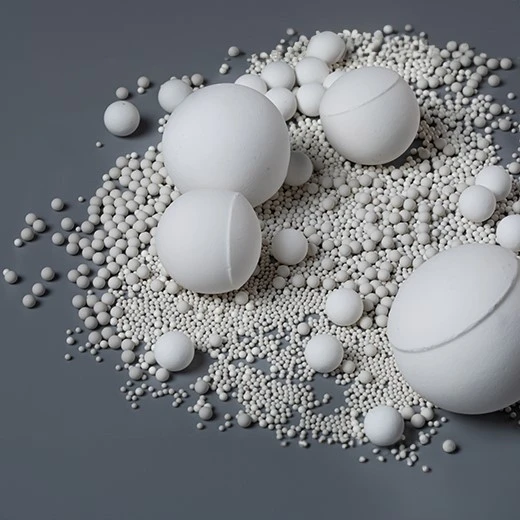
High Alumina Ceramic Ball
Description
Technical Parameters

Products Description
Industrial grinding efficiency is the core factor that directly determines the production output, final product purity, and long-term operating costs of mineral processing plants, ceramic plants, and fine chemical production lines. Traditional grinding media, such as steel balls, typically have high wear rates, heavy metal pollution, and high energy consumption, while high alumina ceramic balls are made from high-purity calcined alumina powder through isostatic pressing and high-temperature sintering. Their dense microstructure has excellent wear resistance, impact resistance, corrosion resistance, and thermal stress resistance, and does not introduce impurity pollution during processing, making them particularly suitable for industries that require strict product cleanliness and stable material quality. This advantage is particularly prominent in ceramic manufacturing, electronic materials, pigments, specialty chemicals, pharmaceutical intermediates, and mineral processing.
Every batch of our Huao products undergoes strict quality inspection to ensure consistency in dimensional tolerances, compressive strength, bulk density, and appearance. This consistency enables customers to achieve predictable performance in different processing environments.
Advantages
1. Wear resistance
The excellent hardness of high alumina ceramic balls enables them to withstand continuous friction in ball mills and grinding systems. Compared with traditional grinding media, it produces less surface wear, helps maintain stable particle size, and reduces pollution caused by media wear.
2. High mechanical strength under heavy load
Industrial grinding equipment often operates under repeated impacts and compressions. High density alumina ceramics have excellent compressive strength, which enables ceramic balls to resist cracking and deformation over a long production cycle. The stable mechanical performance also minimizes unexpected shutdowns caused by the rupture of grinding media.
3. Chemical stability
Under normal operating conditions, high-purity alumina is chemically inert to most acids, bases, and organic substances. This stability can prevent unnecessary reactions with processing materials, making ceramic balls suitable for industries involving pigments, minerals, electronic materials, and specialty chemicals.
4. Heat resistance
Many industrial processes involve high temperatures or frequent thermal fluctuations. Alumina ceramic balls can maintain their structural integrity under these conditions, reducing the risk of thermal shock damage. This feature extends its application range from traditional wet grinding systems to high-temperature production environments.
5. Reduce maintenance and operational costs
Due to the slow wear of ceramic grinding media, the equipment lining and internal components wear less over time. Lower wear means less media replacement, shorter maintenance intervals, and higher equipment availability.
Application
1. Ceramic manufacturing
In ceramic production, high alumina ceramic balls are widely used as grinding media for preparing ceramic slurries. Uniform grinding helps improve particle distribution, resulting in a smoother surface, higher density, and more stable firing performance of ceramic products.
2. Mining and mineral processing
Mineral beneficiation requires effective reduction of particle size before separation and concentration. Ceramic grinding media provide stable grinding performance while introducing impurities into mineral powders.
3. Paint, coatings, and pigments
Modern coatings rely on uniformly dispersed pigments to achieve consistent color and surface finish. Ceramic balls effectively reduce the particle size of pigments while avoiding metal contamination that may affect color stability or chemical properties.
4. Electronic materials
The electronic ceramic industry requires extremely low pollution in the powder preparation process. The alumina grinding medium meets this requirement because it produces very little foreign matter during the grinding process. This makes it suitable for producing advanced ceramic substrates, electronic components, and precision functional materials.
5. Chemical processing
Many chemical products require continuous mixing and fine grinding before further processing. Ceramic grinding media can maintain stable performance even when exposed to corrosive environments, helping manufacturers achieve consistent particle distribution while protecting product purity.
6. Pharmaceuticals and specialty materials
Some pharmaceutical intermediates and specialty powders require grinding systems to minimize metal impurities. Ceramic media provide a cleaner grinding environment, support strict quality requirements, and reduce the risk of contamination during the production process.
7. New energy and advanced materials
With the continuous development of battery materials, fine ceramics, and other advanced functional materials, the demand for high-purity grinding technology is also increasing. Ceramic grinding media can help produce finer and more uniform powders, improve material performance in emerging industries, and enable more reliable manufacturing processes.
Manufacturing process and quality assurance
We control every step of production, from raw material inspection to finished product sorting, to ensure consistent quality between batches and reliable on-site performance.
Production workflow
1. Raw material screening
Only high-purity alumina powder can enter the production system. Each batch of raw materials undergoes chemical composition testing and particle size analysis to confirm compliance with formula requirements.
2. Slurry preparation and spray granulation
The raw materials are mixed with deionized water and sintering aids according to precise formula ratios, and then ground into a uniform slurry. Then, the slurry is dried by spray into flowable spherical particle powder with controllable water content to ensure uniform molding performance.
3. Isostatic pressure
By cold isostatic pressing, the granular powder is formed into a uniform green body. This molding method applies uniform pressure from all directions, eliminating the common density gradient and internal defects in uniaxial compression.
4. High temperature sintering
The green body is fired in a high-temperature tunnel kiln with a precisely controlled temperature curve, reaching up to 1580 ° C. The sintering curve is optimized for each grade to achieve complete densification and target crystal structure.
5. Precision machining and sorting
After firing, the product undergoes rolling and precision processing to achieve a smooth surface, and then passes through multi-stage diameter screening to ensure uniform size.
6. Final inspection and packaging
The finished product undergoes random testing for density, hardness, wear rate, and appearance before packaging and storage.
Quality certification
Our production system and product quality comply with multiple international management system standards, including ISO 9001 quality management system, ISO 14001 environmental management system, and ISO 45001 occupational health and safety management system. All certification audits are conducted by authoritative third-party certification bodies and undergo regular annual supervision audits to ensure ongoing compliance.
Package
Bag with pallets, 25kg/bag or as customized.
1. Pallet size: 1.0m x 1.0m x 0.1m
2. 1000-1300kg/pallet
3. Quantity: 20 pallets for 1 x 20'FCL
4. Max. weight: 25-27tons for 1 x 20'FCL
FAQ
Q1: What is the service life of high alumina ceramic balls in production?
A1: The service life varies depending on the material hardness, grinding speed, filling ratio, and target fineness. Under standard ceramic raw material grinding conditions, the service life of 92% alumina balls is typically 12-18 months, while 95% grades can last for 18-24 months. For harder materials such as quartz and silicon carbide, the wear rate will be correspondingly higher. We can provide more accurate life estimates based on your specific process parameters.
Q2: How to determine the correct filling ratio for the ball mill?
A2: For most wet ball mills, the recommended medium filling rate is 30% to 45% of the effective mill volume. For dry mills, the recommended ratio is 25% to 35%. The optimal filling ratio depends on the mill speed, material feed rate, and target particle size. Excessive filling can lead to high power consumption and increased crushing rate, while insufficient filling can reduce grinding efficiency. Our technical team can calculate the optimal filling amount and size grading based on your device parameters.
Q3: Can 92% alumina balls be used for grinding acidic slurries?
A3: 92% alumina has good tolerance to most weak acids and neutral solutions. For strong acid environments such as hydrochloric acid and sulfuric acid systems, we recommend using products with a purity of 95% or higher, which have better chemical corrosion resistance. For specific corrosive media, please contact our technical team for material compatibility assessment.
Q4: Do you provide product samples for performance testing?
A4: Yes, we provide free small batch samples for laboratory testing and performance validation.
Q5: What is the standard delivery cycle for bulk orders?
A5: For products with standard sizes and grades in inventory, we can arrange shipment within 3-7 working days after order confirmation. For customized sizes or large orders exceeding 20 tons, the typical delivery cycle is 15-25 working days, depending on the production schedule. We will confirm the exact delivery time when placing the order.
Photo show
|
|
|
|
|
|



Product Quality Certification

Factory Show

Hot Tags: high alumina ceramic ball, China, manufacturers, suppliers, factory, customized, buy, Alumina Ceramic Packing Ball, Alumina Ceramic Grinding Balls, irconia Ceramic Beads, Ceramic Mocaic Tiles, Mosaic Tiles, Alumina Lining Tile
Technical specification
Grinding ball (Wet Grinding)
|
Brand |
HA-92 |
HA-92S |
HA-95 |
|
Al2O3 (%) |
≥92 |
≥92 |
≥95 |
|
Bulk Density (g/cm3) |
≥3.65 |
≥3.68 |
≥3.68 |
|
Hardness (Mohs) |
9 |
9 |
9 |
|
Wear Loss (%) |
≤0.01 |
≤0.008 |
≤0.01 |
|
Water Absorption (%) |
≤0.01 |
≤0.01 |
≤0.01 |
|
Color |
White |
White |
White |
| Diameter Range | 0.5mm – 30mm | 0.5mm – 30mm | 0.5mm – 30mm |
| Noted: Size can be customized according to customer's requirement. | |||
Grinding Ball (Dry Grinding)
|
Brand |
HA-92 |
HA-95 |
|
Al2O3 (%) |
≥92 |
≥95 |
|
Bulk Density (g/cm3) |
≥3.60 |
≥3.65 |
|
Hardness (Mohs) |
9 |
9 |
|
Wear Loss (%) |
<0.015 |
<0.012 |
|
Water Absorption (%) |
<0.01 |
<0.01 |
|
Color |
White |
White |
|
Size |
13-90mm |
|
|
Noted: Size can be customized according to customer's requirement. |
||
Previous
Inert Packing BallsNext
99.7 Ceramic SheathSend Inquiry