

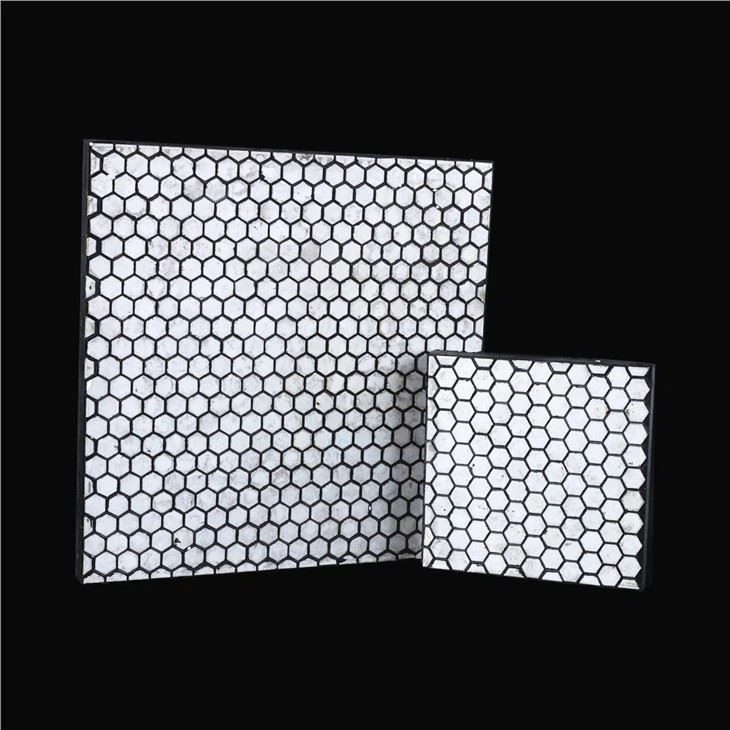
Cn Bonding Layer Wear Plate Alumina Ceramics Lining Rubber Backed Ceramic Composite Plate
Description
Technical Parameters
With this motto in mind, we have turn out to be amongst probably the most technologically innovative, cost-efficient, and price-competitive manufacturers for Wear Resistant Panel, Alumina Ceramic Grinding Ball, Alumina Ceramic Mosaic Tiles. We will strengthen the coverage and management of different sales areas. We would love to provide you with further information. We welcome buyers all around the word to make contact with us for foreseeable future small business associations. The main intention of our firm is to build up a satisfying memory for all consumers, and set up a long-term win-win small business connection.
Products Description
In bulk material handling systems, wear and tear does not occur in a single form. When materials fall from a higher position, the chute may suddenly be loaded and then continue to slide as the materials move in the equipment. At the transfer point, the impact may be concentrated in a relatively small area, while the downstream surface is mainly subjected to friction and wear. Therefore, the lining system needs to deal with more than just simple surface wear.
The impact ceramic lining plate is designed around this combination of working conditions. Its structure typically consists of three functional layers: an alumina ceramic surface, an elastic rubber backing, and an optional metal base. Each layer has a different function. Ceramics provide a contact surface that resists abrasive particles, while rubber acts as a shock-absorbing layer between ceramics and equipment structures. If a rigid mechanical base is required, a steel backplate can be added to the panel.
This layered structure is particularly useful in locations where traditional hard ceramic liners may be exposed to repeated impacts. The rubber part provides a certain degree of cushioning, rather than directly transferring each mechanical load to the equipment casing. Effectively solved the problem of pure ceramic lining cracking under strong impact, and extended the service life of the equipment by 3-5 times.
Advantages
1. Double protection to prevent impact and wear
The impact ceramic lining plate combines the high wear resistance of alumina ceramics with the excellent impact buffering performance of rubber. The surface ceramic layer resists the cutting wear of hard materials, while the middle rubber layer absorbs impact energy through elastic deformation and disperses the impact force transmitted to the ceramic and equipment substrate. It can withstand continuous impact of bulk materials falling more than 5 meters, solving the common problem of rapid fracture and failure of pure ceramic lining and cast stone lining at high impact positions. Under the same impact wear conditions, its service life is 2-3 times that of high chromium cast iron lining and 5-8 times that of ordinary manganese steel lining.
2. Noise reduction and vibration reduction effect
The rubber buffer layer can effectively absorb the vibration and noise generated when the material hits the equipment wall. Compared with steel lining and pure ceramic lining, the working noise of the equipment is reduced by 10-15 dB. It improves the working environment of the production workshop, reduces the vibration damage caused by long-term material impact on the equipment body, and extends the overall service life of the equipment structure.
3. Modular design for quick installation and maintenance
This product is supplied in the form of standard modular panels and prefabricated in the factory. On site installation only requires fixing the panels one by one through bolts or welding, without the need to mix adhesives on site and wait for curing. Installation efficiency is 3-4 times higher than sticking ceramic lining, which can greatly shorten equipment downtime for maintenance. When local wear and tear occur, only the damaged panel needs to be replaced without the need for overall disassembly, greatly reducing maintenance costs and downtime.
4. Reliable adhesion that will not come off
Ceramics, rubber, and backboards are integrally formed through high-temperature and high-pressure vulcanization processes, rather than simple adhesive bonding. During the vulcanization process, the rubber completely penetrates into the gaps of the ceramic unit, forming a strong mechanical joint. The peel strength between rubber and ceramic reaches 4MPa, and the overall peel strength of the panel reaches 6MPa. Under normal use, ceramics will not fall off or delaminate, ensuring long-term stable operation of the lining.
Application
1. Transfer chute in bulk material handling
The conveyor trough receives materials from conveyors, feeders, or elevated equipment. The combination of falling distance and material velocity can cause severe local impacts. The impact ceramic lining plate can be installed in the receiving area and other concentrated wear points to protect the surface of the chute from repeated particle contact.
2. Mining ore processing system
Crushed ore may contain hard particles with irregular shapes and considerable mass. When these materials enter the hopper, chute, or transfer equipment, the impact generated will quickly damage the unprotected steel. Ceramic rubber plates are suitable for areas subjected to heavy material impact and sustained wear.
3. Coal preparation and transportation
The coal conveying equipment processes a constant flow of granular materials through coal bunkers, feeders, chutes, and transfer stations. Rubber backed ceramic panels can be used in locations where coal repeatedly impacts equipment walls, helping to protect the underlying steel while adapting to mechanical impacts.
4. Cement and clinker processing
Cement plants transport abrasive raw materials, clinker, and other mineral products through numerous conveying systems. Chutes and hoppers may experience sliding wear and direct impact. Ceramic rubber lining can be selectively applied to the parts exposed to the maximum material load, rather than unnecessarily lining every surface.
|
Application |
Fastening Methods |
Backing Plates |
|
Raw Material Feed |
Rubber Bond |
Plain Rubber with Captive Studs |
|
Head Chute Liner |
Studs |
Mild Steel |
|
Impact Curtains |
Captive Socket |
3 Cr12 |
|
Chute Liner |
Plug Weld |
Stainless Steel |
|
Rock Boxes |
||
|
Skirt Boards |
||
|
Bucket Liner |
Product photos
|
|
|
| Panel with Cylinders | Panel with Hex |
|
|
|
| Panel with Tiles | Panel with Triangle |
|
|
|
| Panel with Backing Plate | Panel with Dimple Tiles |


Specifications
|
Material Properties |
Units |
Value |
|
|
Rubber |
Tensile Strength |
Mpa |
16 |
|
Break Extension |
% |
450-500 |
|
|
Shore Hardness |
- |
60±5 |
|
|
Break Permanent Deformation |
% |
30 |
|
|
Main Composition |
|
Natural Rubber+SBR |
|
|
Peel Strength between rubber and ceramic/rubber and steel |
Mpa |
6 |
|
|
Bonding Strength between rubber and ceramic |
Mpa |
4 |
|
|
Panel Size |
300x300, 200x200, 225x225, 250x250, 400x400, 425x425,500x500, 600x600 |
|
Ceramic Size |
Ceramic tiles are available from 10x10mm to 100x150mm; thickness |
|
Backing Plate |
Steel plate with thickness ranging from 3mm to 10mm(Optional) |
|
Rubber Thickness |
Depends upon the impact stress expected or customer requirement. |
|
Remarks |
Metal+Rubber+Ceramic/Rubber+Ceramic |
Why Choose Us?
1. Designed specifically for areas with high impact force
Not all wear problems are caused by sliding wear. Repeated impacts in the conveyor trough, loading point, and material drop area are also destructive. Our ceramic rubber lining solution is developed for these conditions, combining a hard ceramic surface with an elastic backing layer to provide surface protection and impact absorption.
2. Quality assurance of integrated vulcanization process
Our impact ceramic lining plate are all formed using an integrated high-temperature vulcanization process, rather than a secondary bonding process. The bonding strength between layers is much higher than that of adhesive products, and there will be no delamination or ceramic detachment during use. Each batch of products will undergo peel strength testing and impact testing, and we can provide corresponding test reports to ensure reliable product quality.
3. More suitable for vibration equipment
Mining and bulk material handling equipment often operate under continuous vibration. A suitable rubber backed ceramic panel can adapt to a certain degree of movement while maintaining contact with the protected surface. This makes it a practical choice for devices exposed to impact and wear.
4. Rich support for ceramic templates and panel specifications
We have over 20 types of ceramic unit molds and more than 10 standard panel sizes, supporting various ceramic arrangements such as square, hexagonal, cylindrical, and concave pits to meet the needs of different working conditions. We also support customized production of irregular panels for curved surfaces and elbows, to fully fit the equipment walls.
FAQ
Q1: Where is the rubber backed ceramic plate usually installed?
A1: They are often used for conveying chutes, hoppers, feeders, conveyor loading points, unloading areas, and other locations where bulk materials fall or change direction. These areas typically experience greater impact than regular conveyor sections.
Q2: Why add rubber behind ceramics?
A2: The rigid ceramic layer provides excellent surface protection, but has limited flexibility. Rubber backing provides cushioning and helps reduce the impact transmitted to the equipment structure, making the composite material structure more suitable for locations that are susceptible to impact.
Q3: How should the thickness of the panel be selected?
A3: The thickness should be determined by the severity of the working environment, not just the size of the equipment. Before making a choice, material density, particle size, drop height, impact frequency, and expected service life should be considered.
Q4: Can these panels be used for curved or irregular devices?
A4: It is possible to consider customizing panel sizes and configurations for different device structures. Customers can provide drawings, dimensions, or photos of the worn area to recommend a more suitable configuration.
We are vigorous and ambitious with a worldwide vision. With talented people, first class management, high quality products and feasible business model, our company leads the Cn Bonding Layer Wear Plate Alumina Ceramics Lining Rubber Backed Ceramic Composite Plate industry. We can customize production according to the needs of each customer, and insist on satisfying users is our company's unremitting pursuit! Strict quality control is executed in each link of the whole production process.
Hot Tags: Impact Ceramic lining Plate, China, manufacturers, suppliers, factory, customized, buy, ZTA Grinding Beads, Alumina Ceramic Wear Resistant Liner, Refractory Materials, Alumina Ceramic Lined Elbow, Reaction Bonded Silicon Carbide Wear Resistant, Alumina Grinding Ball
Send Inquiry
You Might Also Like


