

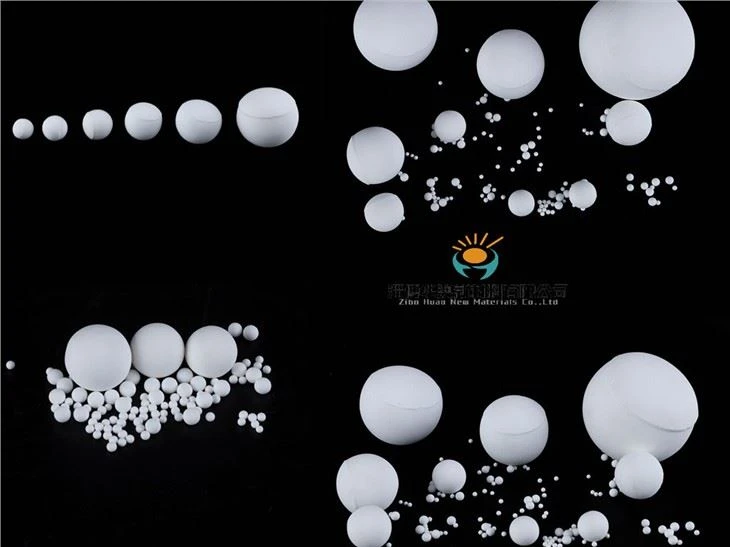


Wear Resistant Alumina Ceramic Ball
Description
Technical Parameters

Products Description
The grinding medium directly affects the efficiency of the mill in converting mechanical energy into reduced particle size. During the operation, the ball repeatedly passes through the material bed, producing a combination of impact, compression, and friction. Therefore, the selection of ceramic media should be based on the entire grinding process, rather than simply comparing the percentage of alumina displayed on the specification sheet.
Wear resistant alumina ceramic balls are made of high-purity alumina powder. Before shaping the raw material into a spherical medium, it is processed to obtain the desired particle distribution. According to production methods and specifications, forming may involve pressing, rolling, or other controlled techniques. Then dry the formed balls and fire them at high temperature. During the sintering process, ceramic particles bind together and the internal structure becomes increasingly dense. After cooling, inspect, classify, and prepare the finished medium according to the required size range.
Ball diameter is an important component of milling settings. Larger media can generate stronger mechanical effects, and when the feed contains relatively coarse particles, it is usually considered to use larger media. Smaller balls provide more contact points, and are often chosen when finer grinding or improved dispersion is required. In actual production, mills may use multiple ball diameters to create a suitable grinding environment, rather than relying on a single diameter.
Advantages
1. Stable grinding behavior during continuous milling process
Wear resistant alumina ceramic balls will not simply break the material into smaller particles. During the operation, the ball repeatedly collides and rubs against the material inside the mill. Producing high-quality alumina balls maintains a relatively stable shape and surface condition during this process, which helps to make grinding actions more predictable during extended production periods.
2. Reduce medium consumption in abrasive processing
The grinding medium itself is exposed to continuous mechanical contact. Excessive wear means more frequent replenishment and may also alter the operating condition of the mill. Alumina ceramics provide a hard working surface that can resist gradual material loss. When the ball size and operating parameters are appropriately matched, this helps reduce medium consumption.
3. Effective balance between impact resistance and wear resistance
Grinding is rarely a single type of mechanical action. According to the design of the grinder, the medium may be subjected to impact, compression, and sliding simultaneously. The ceramic structure provides the required hardness for grinding contact while maintaining sufficient mechanical integrity for repeated movement within the grinding chamber.
4. Reduce the risk of metal pollution
For certain powders, contamination from traditional metal grinding media can cause quality issues. Alumina ceramics provide a non-metallic alternative, making them very useful when manufacturers need to limit iron or other metal impurities in processed materials. This is particularly relevant to ceramic powders, pigments, mineral products, and certain specialty materials.
5. Chemical stability during material processing
Grinding can be carried out in water, alkaline solutions, acidic environments, or other process liquids. Alumina ceramics typically have good chemical stability under many industrial conditions, allowing the grinding medium to maintain its functionality without easily reacting with the processing material. The actual applicability should still be confirmed based on the specific chemical properties of the slurry.
Applications
1. Refractory and grinding materials
Refractory material manufacturers grind bauxite, magnesium oxide, silicon carbide, and zircon for use in castables and bricks. These materials have high wear resistance - silicon carbide (Mohs hardness 9.5) is harder than aluminum oxide. For silicon carbide, zircon, and fused alumina, use 95% or 99% balls to accept slightly higher wear in exchange for no metal contamination. For magnesium oxide and dolomite (Mohs hardness 4-5), 92% of the balls have excellent service life. Dry grinding is common, using 30-80mm balls in large mills.
2. Minerals and Metallurgy
Although steel balls dominate in primary hard ore grinding, alumina balls are used in secondary and re grinding circuits for pollutants and non-metallic minerals (kaolin, calcium carbonate, talc, barite). In the processing of calcium carbonate for paper coatings and plastic fillers, 92% of the 10-40mm balls grind limestone to<2 μ m, resulting in minimal pollution. For lithium minerals (spodumene, lithium mica) used as battery materials, a 95%+ball can ensure that transition metal contamination does not affect battery performance.
3. Chemistry and pharmaceuticals
Chemical manufacturers grind catalysts, fertilizers, insecticides, and specialty chemicals. The inertness of alumina is crucial: it does not react with acidic/alkaline raw materials or catalyze unwanted reactions. In catalyst production, finely grinding zeolite and support to precise sizes can control surface area and activity; 99% of the 0.5-2mm beads in the stirring mill achieved zero pollution. Pharmaceutical excipients are ground using over 95% balls to meet the purity requirements of FDA and the European Union.
4. Building materials (cement, glass)
Although steel balls dominate in cement clinker grinding, wear-resistant alumina ceramic balls are used in white cement, dental cement, and high-purity calcium aluminate cement, where iron contamination can affect color or solidification. In the preparation of glass ingredients, alumina balls grind silica sand, feldspar, and soda ash to a uniform fineness without introducing pollutants that cause glass defects (bubbles, stones, color changes).
Technical specification
Wet grinding
|
Brand |
HA-92 |
HA-92S |
HA-95 |
|
AL2O3(%) |
≥92 |
≥92 |
≥95 |
|
Bulk density(g/cm³) |
≥3.65 |
≥3.68 |
≥3.68 |
|
Hardness(Mohs) |
9 |
9 |
9 |
|
Wear Loss(%) |
≤0.01 |
≤0.008 |
≤0.01 |
|
Water Absorption(%) |
≤0.01 |
≤0.01 |
≤0.01 |
|
Color |
White |
White |
White |
Dry grinding
|
Brand |
HA-92 |
HA-95 |
|
AL2O3(%) |
≥92 |
≥95 |
|
Bulk density(g/cm³) |
≥3.60 |
≥3.65 |
|
Hardness(Mohs) |
9 |
9 |
|
Wear Loss(%) |
≤0.015 |
≤0.012 |
|
Water Absorption(%) |
≤0.01 |
≤0.01 |
|
Color |
White |
White |
|
Size |
13-90mm |
|
|
Size can be customized according to customer's requirement |
||
Selection and Usage Guide
Principle of Ball Size
The optimal granularity depends on three factors:
(1) Feed particle size - coarser feed requires larger balls; The largest ball should be 10-15 times the maximum feeding size;
(2) Target fineness - finer products require smaller balls to obtain more contact points; In the stirring mill, use 0.5-5mm for sizes below 10 μ m;
(3) Grinding machine diameter - larger grinding machines produce higher impact velocities and can use larger balls; Grinding machines with a diameter greater than 3 meters can use up to 90 millimeters, while grinding machines with a diameter less than 1 meter should not exceed 25 millimeters. Graded distribution (4-7 sizes) is always better than a single size: larger balls provide impact, while smaller balls fill gaps for wear.
Operation prompt
Loading capacity: 38% -42% (wet), 30% -35% (dry). Overload can reduce impact; Insufficient load will reduce throughput.
Mud density: The solid content of ceramic mud is 60-75% by weight. Mud that is too thin can cause sliding; Too thick will increase viscosity.
Regular Recharge: Recharge with the maximum size every 2-4 weeks to maintain the rating. Monitor consumption situation; Sudden increase may indicate process issues.
Grinding speed: The wet critical speed is 65-75%, and the dry critical speed is 70-80%.
quality assurance
Each batch has undergone:
(1) Detecting the raw material components and measuring the particle size through laser diffraction;
(2) Process monitoring of spray drying particle moisture and fluidity, green ball weight and continuous kiln temperature recording;
(3) Finished product testing, including bulk density (mercury displacement), alumina content (XRF), wear (standard 5-L laboratory grinder, containing silica sand, 2 hours), water absorption (boiling method), compressive strength (10+balls per batch), particle size distribution verification (5-kg sample), and sphericity (50 balls, three-axis micrometer);
(4) Pre shipment documents, including batch test reports, certificates of origin, and packaging photos. Third party inspections (SGS, BV, Intertek) can be provided upon request.
FAQ
Q1: What is the purpose of wear resistant alumina ceramic balls?
A1: Wear resistant alumina ceramic balls are mainly used as grinding media to reduce the particle size of solid materials. It can be used for ball mills, pot grinders, and other grinding equipment that require ceramic media.
Q2: How does the size of the steel ball affect the grinding performance?
A2: Larger balls provide stronger impact during the grinding process and can be used for relatively coarse feed. Smaller balls provide more contact points and are usually more suitable for fine grinding. Many production systems use combinations rather than relying on a single size.
Q3: Can alumina ceramic balls be used for wet grinding?
A3: Yes. Alumina ceramic media is widely used in wet grinding. When determining the appropriate medium specifications, customers should consider the viscosity of the slurry, liquid composition, grinding speed, filling ratio, and target fineness.
Q4: How to calculate the ball material of the grinder?
A4: During wet grinding, the ball material accounts for 38-42% of the volume of the mill. Multiply the volume of the grinder (π× r ² × L) by the loading percentage, and then multiply by the bulk density (3600-3700 kg/m ³). Example: Diameter 2 meters x length 4 meters, 40%: volume=12.57 cubic meters, ball volume=5.03 cubic meters, weight ≈ 18360 kilograms. We provide accurate calculations based on your factory drawings.
Q5: Do you provide samples?
A: Yes, free samples of 1-2 kilograms of standard grade. For customized products, provide trial samples based on production costs. Many customers conduct 2-4 weeks of testing before shipment before committing to full load; We provide technical guidance and performance comparison data.
Need the right ceramic grinding media?
Hot Tags: Wear Resistant Alumina Ceramic Ball, China, manufacturers, suppliers, factory, customized, buy, Ceramic Mocaic Tiles, Mosaic Tiles, Zirconia Alumina Balls, Alumina Lining Tile, White Tabular Corundum, Alumina Ceramic Packing Ball
Send Inquiry


